







+49 5402 96526-10 Mon-Fr 9a.m.-6p.m.
Email mail@trailer.one
Address
Aktion Woche 2
In this article, we explain how to connect your trailer’s breakaway cable to your towing vehicle, what differences apply in Germany, the Netherlands, Switzerland and Austria – and how to avoid expensive fines.
What does the breakaway cable actually do?
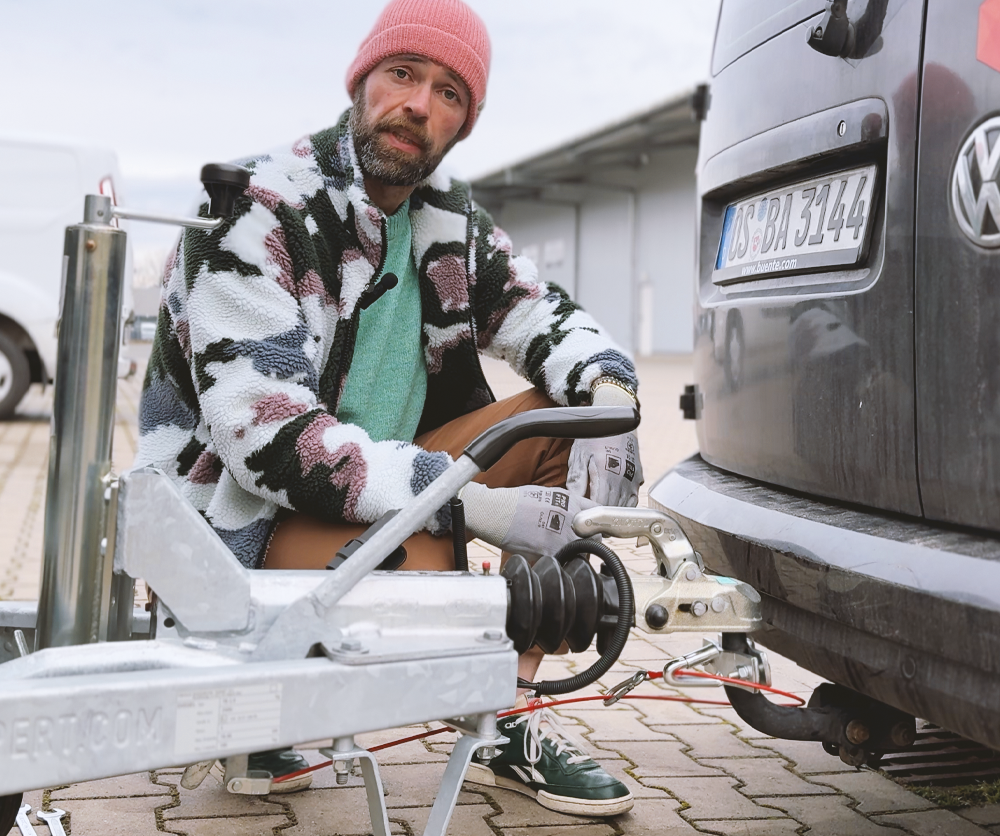
The breakaway cable is an important safety feature on braked trailers with a permissible gross weight of over 750 kg. It is attached to the trailer’s handbrake lever and is placed in a loop over the towbar when coupling up.
If the trailer detaches from the towing vehicle while driving, the cable tightens, automatically applies the handbrake – and the trailer comes to a stop on its own. In this way, the breakaway cable prevents your trailer from rolling on uncontrollably and endangering other road users.
Breakaway cable in Germany – the current situation
In Germany, the following applies:
For all braked trailers, a breakaway cable is mandatory. However, the law does not specify exactly how it must be attached to the towing vehicle. This means: you may simply place the cable as a loop over the towbar – this is legally permitted.
There is one exception, however, if your towbar has a dedicated attachment eye. In that case, the breakaway cable must be hooked into it – and not simply placed loosely over the towbar.
"A breakaway cable is mandatory for all braked trailers. In Germany, you may place it as a loop over the towbar."
Different countries, different rules
Anyone travelling abroad with a trailer should know the differences. In neighbouring countries, the topic of securing the breakaway cable is handled much more strictly.The Netherlands
Here, all trailers – whether braked or unbraked – must be connected to the towing vehicle with a breakaway cable or safety chain. Important: it is not sufficient to simply place the cable as a loop over the towbar. The cable must be hooked into a fixed eye, clamp or shackle. This is intended to prevent the cable from slipping off due to vibrations and failing to activate the brake in an emergency.
Switzerland
Switzerland has similar regulations to the Netherlands. The breakaway cable must be firmly connected to the vehicle – a loose loop is not permitted. Retrofit solutions, such as the so-called Holland eye, are not always accepted, especially with detachable towbars.
Particularly important:
Since 2023, the improper attachment of the breakaway cable has been considered a moderately serious offence in Switzerland.
This can have serious consequences, such as a fine and a four-month driving ban – even for German drivers!
Austria
In Austria, too, a safety connection (cable or chain) is mandatory. Although there is no exact rule on how it must be attached, it must be implemented securely. With a Holland eye, you are therefore also on the safe side during checks.
The Holland eye – a simple retrofit solution for added safety
If your vehicle does not have a fixed attachment eye, you can easily retrofit one: with a so-called Holland eye.
It is attached to the towbar carrier and provides a secure attachment point for the breakaway cable.
Here is how it works:
-
Attach the Holland eye to the towbar carrier
-
Feed the breakaway cable through the eye
-
Place the cable in the usual loop over the towbar
-
Hook it in – done!
This prevents the cable from slipping off, allowing you to remain legally compliant when travelling abroad.
Tip: if your towbar has a small eye, use a carabiner with a high breaking load (in accordance with DIN 5299) to extend it. This ensures that the connection will hold in an emergency.
Why the effort is worthwhile
Many trailer combinations are regularly inspected, especially in the Netherlands and Switzerland.
Anyone who only places their breakaway cable loosely over the towbar risks:
-
high fines (over €100 in Austria, up to €600 in Switzerland)
-
in the worst case, a driving ban
-
and, of course, a significant safety risk
With a Holland eye or an approved attachment eye, you are on the safe side – no matter which country you are travelling in.
Conclusion: small eye, big impact
The breakaway cable is more than just a piece of wire with a hook – in an emergency, it can save lives.
Anyone who regularly travels abroad with a trailer should familiarise themselves with the relevant regulations and retrofit their towbar with a Holland eye.
That way, you are:
-
safe on the road,
-
legally compliant in all neighbouring countries,
-
and avoid expensive penalties.
| HELPFUL LINKS |
| > to the thread on anhaengerforum.de |
Recent posts
- Mehr Umsatz, weniger Aufwand: Warum du als Händler auf dem Trailer.One B2B-Marktplatz einsteigen solltest
- Stützrad-Tests auf dem Prüfstand: Warum die angegebene Stützlast nur die halbe Wahrheit ist
- Meilensteine, Mythen & Krisen: Die echte Geschichte der Westfalia-Anhänger
- Auflaufbremse am PKW-Anhänger: Wann reparieren, wann austauschen?
- Bremsentechnik am PKW-Anhänger: Originalteil oder Nachbau?
- Frühlings-Release 2026 online! Viele sinnvolle Verbesserungen warten auf euch
- Aktionswoche 3
BÜNTE Marketplace GmbH
Gewerbepark 18
49143 Bissendorf | Germany
Phone: +49 5402 96526-10
Mail: mail@trailer.one
Mon.–Thur.: 8.00 a.m.–5.00 p.m
Fri.: 9.00 a.m.–2.00 p.m.
© 2022 - 2026 Bünte Marketplace GmbH.