 Main categories Quick access via the main categories
 Complete product range Overview of our complete product range
 Product finderPRACTICAL Find your product in three steps – with the spare parts finder
 Special offersSALE Overview of our limited-time special offers
 Info centre Expert knowledge all about your trailer
 Bulk buyer enquiry Your enquiry – our matching suppliers



+49 5402 96526-10 Mon–Thu: 9:00 am–5:00 pm and Fri: 9:00 am–2:00 pm
Email mail@trailer.one
Address
Milestones, myths & crises: the history of Westfalia trailers
When the name “Westfalia” comes up, most people immediately think of two things: the iconic VW camper van with pop-up roof or the classic towbar under a car. What is often forgotten, however, is that the history of Westfalia is deeply and inseparably connected with the construction of car trailers.
In fact, hardly any other company has shaped car trailer technology as significantly as this business from North Rhine-Westphalia. In this Trailer.One blog article, we take you on a precisely researched journey through the fascinating – but also highly dramatic – history of Westfalia trailers.
1844 – 1927: From blacksmith’s forge to the road
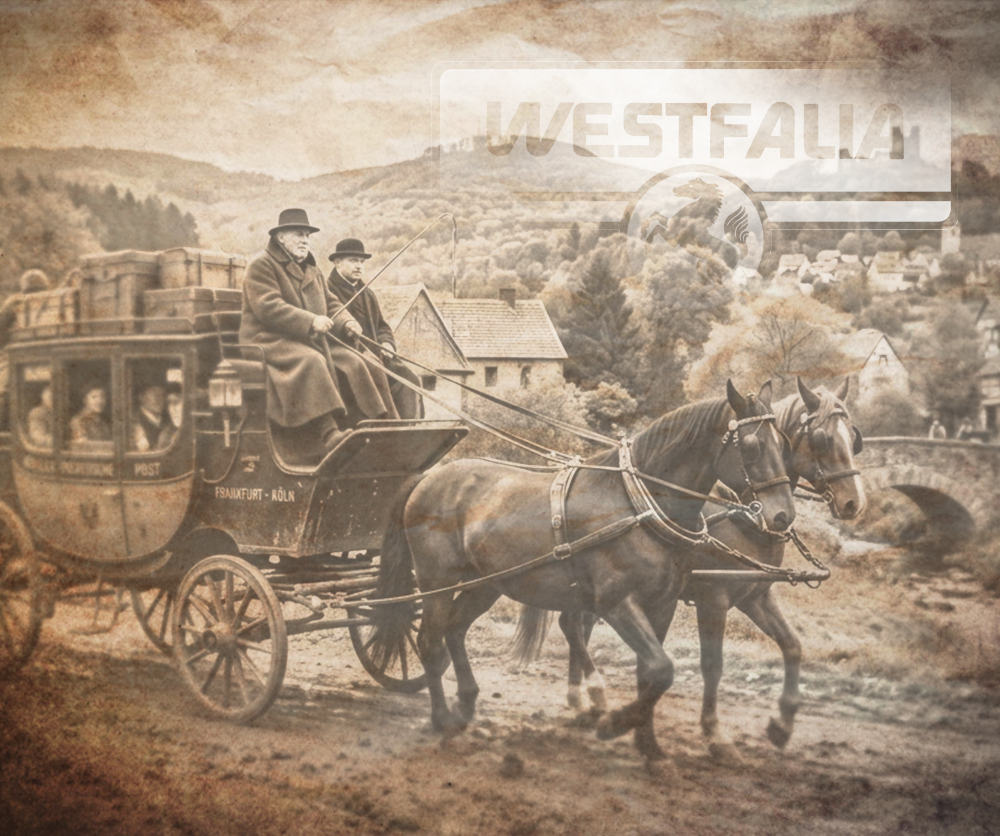
The story begins long before the invention of the automobile. In 1844, Johann Bernhard Knöbel opened a blacksmith’s forge in Wiedenbrück and began building heavy horse-drawn wagons and carriages. Business flourished.
However, with the beginning of the 20th century and increasing motorisation, the market for carriages collapsed dramatically. The company, which from 1922 traded under the name Fahrzeugfabrik Westfalia – Franz Knöbel & Söhne OHG, had to rethink its strategy. The logical step: if the carriage no longer had horses, it would have to be pulled by a car instead. In 1927, the very first classic passenger car trailer left the Westfalia factory halls.
1932: An invention that changed towing worldwide
Before talking about the trailers themselves, we first need to take a quick look at the connection to the car. Until the 1930s, trailers were towed using rattling pin, eye or claw couplings. It was jerky, noisy and unsafe.
Franz Knöbel worked on a solution and in 1932 presented an invention that still dominates vehicle engineering today: the 50 mm ball hitch coupling. Inspired by the human joint, he patented the system of the ball and enclosing socket worldwide on 14 March 1934. Without this milestone from Westfalia, modern car trailer construction would not exist in its current form.
1968: The legendary Westfalia chassis sets new standards
While simple and inexpensive rubber torsion axles conquered the trailer market during the 1960s and 70s, Westfalia took a completely different – and far more sophisticated – approach.
In 1968, Westfalia introduced an independent wheel suspension system with trailing arms, coil springs and shock absorbers. This technology was originally known from passenger cars and offered an unmatched level of ride comfort. Uneven surfaces were not simply “bounced over” but smoothly absorbed.
Another technical masterpiece followed in 1985: on tandem trailers, the trailing arms were arranged in opposite directions. The huge advantage? The trailer no longer dipped under braking, and contact between all four tyres and the road surface was guaranteed at all times. This patented suspension system made Westfalia the undisputed market leader in the field of horse trailers (legendary models such as Joker, Jupiter and XXL), as the smooth, vibration-free transport was invaluable for the animals.
1997 – 2004: The split-up and the dark years
Despite its technical brilliance, dark clouds gathered over the traditional company towards the end of the 1990s. The market became tougher, and production costs for the sophisticated suspension systems were high.
In an attempt to save the company, the Westfalia Group was split into three independent GmbHs in 1999:
-
Westfalia-Automotive (towbars)
-
Westfalia Van Conversion (motorhomes, later absorbed by DaimlerChrysler)
-
Westfalia-Trailergroup GmbH (the actual trailer division)
The trailer division, which had already acquired the struggling competitor Heinemann in 1997, fell into severe financial trouble. In 2002, Westfalia-Trailergroup filed for insolvency. Former employees still attempted to save the company by founding Westfalia-Heinemann AG, but this effort also failed: in 2004, the company went bankrupt again – and this time for good – in Wiedenbrück. A bitter chapter for German engineering.
2005 to today: New beginnings in Saxony and Austria
Was that the end of Westfalia trailers? Not quite! In 2005, Westfalia Trailer Systems GmbH was newly founded. The company purchased the trademark rights, construction plans and production tools from the insolvency estate. Production left its historic home of Wiedenbrück, and Westfalia trailers were manufactured in Obergoseln in Saxony.
Following the insolvency of the owner group, the brand was sold to Austria, where it continues to exist today.
Conclusion: A rolling legend
Whether you drive a brand-new Westfalia trailer today or own a robust “classic” from the 1980s with the legendary trailing arm suspension system standing in your yard – your trailer contains more than 180 years of vehicle engineering history.
And if that very suspension system or overrun device needs new wear parts after many loyal years of service: at Trailer.One you will find the right shock absorbers, brake linings and accessories to keep your rolling legend technically perfect and safe on the road!
No posts found
Write a review
Recent posts
- Transformation in the Chassis Market: The Recent History of AL-KO Vehicle Technology
- The ETI Number Explained: The Key to Finding the Right AL-KO Spare Part
- Firewood Season Begins: How to Transport Firewood Safely with a Trailer
- Why Trailer Nets Are Usually Not Enough to Secure a Load
- Chapel Flex-e-Pump Put to the Test: The Perfect Solution for Cordless Drill-Powered Tippers or Unreliable Technology?
- From an East German Classic to Modern Mass Production: The Evolution of HP Trailers and the STEMA Brand
- Schlegl Axles in Focus: The Solid Alternative for Your Car Trailer
TrailerOne GmbH
Gewerbepark 18
49143 Bissendorf | Germany
Phone: +49 5402 96526-10
Mail: mail@trailer.one
Mon.–Thur.: 9.00 a.m.–5.00 p.m
Fri.: 9.00 a.m.–2.00 p.m.

© 2022 - 2026 TrailerOne GmbH.